Project details
Year: 2016 – on going
Role: Coordinator
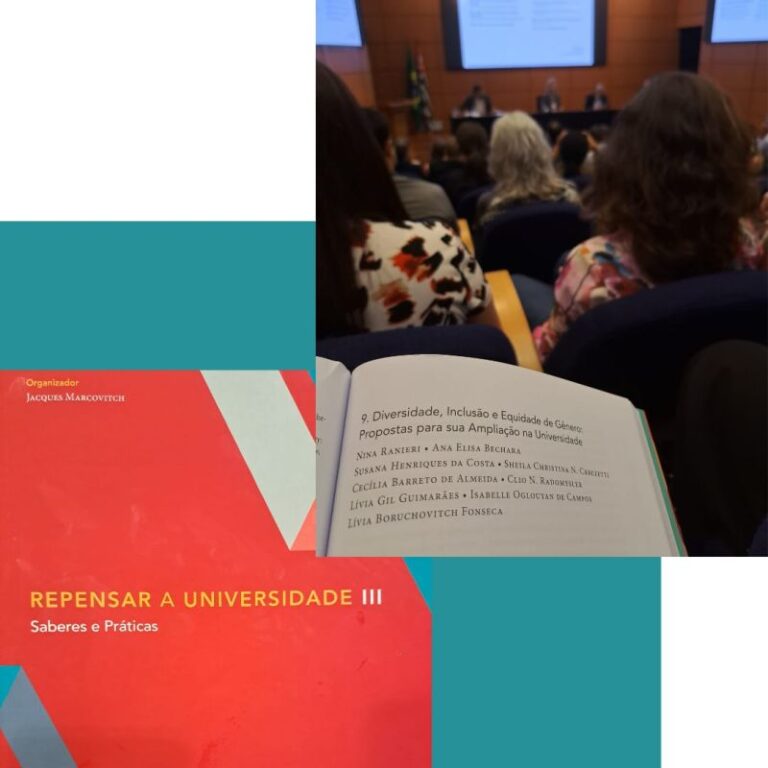
Description: In 2025, I co-founded the Centre for Inclusion in Academia (GPEIA) at the University of São Paulo Law School (USP). The group was part of a broader movement to examine the relationship between legal education, institutional exclusion, and equality policies. GPEIA combines empirical research and university outreach to investigate inequalities within academic institutions and the legal profession. Its work examines how student and faculty demographics, teaching practices, institutional cultures, and university policies shape opportunities for participation, recognition, and professional advancement. Currently, Professor Sheila Christina Neder Cerezetti coordinates the group, alongside Lívia Gil Guimarães, Isabelle Oglouyan de Campos, and me. GPEIA is registered in the National Council for Scientific and Technological Development (CNPq) research group directory and the Committee of Culture and University Extension (CCEx) from the University of São Paulo Law School.
GPEIA seeks to produce rigorous empirical evidence that can inform institutional reforms and promote more inclusive academic environments. Its activities connect research with public engagement through academic publications, conferences, teaching activities, and discussions with universities, legal professionals, and civil society organisations. The group aims to improve legal education, encourage anti-discriminatory teaching practices, increase diversity among students, faculty, and administrative staff, and challenge direct and indirect discrimination in educational and professional settings.
The group’s research agenda encompasses three major projects. Its first study examined gender interactions in USP Law School classrooms, investigating how everyday teaching practices and interpersonal dynamics contribute to a hidden curriculum that may reproduce gender inequalities. A second project compares women’s and men’s academic careers in the Faculty of Law, highlighting their different opportunities and challenges. Finally, a third project investigated ethnic-racial relations at USP Law School after the introduction of racial quotas in 2018, focusing on the experiences of students from different racial and ethnic backgrounds – but this project has been discontinued. Together, these projects examine how inequalities are produced and experienced within universities and how research can support institutional change.
To keep track of GPEIA’s news, projects and social media, access: https://linktr.ee/gpeia
Impact: One of GPEIA’s principal outputs was the publication of “Gender Interactions in University of São Paulo Law School Classrooms: A Hidden Curriculum?” (2019), produced through USP’s UNESCO Chair on the Right to Education. The book presented the group’s first empirical research findings and helped establish gender inequalities in legal education as a subject of academic and institutional debate. Revista Quatro Cinco Um recognised it as one of the best books of 2019 in the feminism and gender category. The research also informed a thematic series coordinated by GPEIA in JOTA, extending the discussion to a wider audience of legal scholars, practitioners, and educators. Based on the findings of GPEIA’s first book, alongside professors and other colleagues, we co-created a new bachelor’s module on Law and Gender Equity at the University of São Paulo.
GPEIA’s research gained visibility through academic conferences, public debates, podcasts, lectures, and media coverage, including Nexo, Folha de S.Paulo, Rádio CBN, Revista Pesquisa FAPESP, and Migalhas. Its members shared their findings with universities, law firms, and civil society organisations, encouraging discussion about gender, diversity, and institutional discrimination. The group’s methodology and findings also attracted interest from Brazilian and international institutions, including Insper, FGV Direito SP e FGVDireito Rio, PUC-SP, ENFAM, the Federal University of Paraná, Federal University of Ceará, Federal University of Pernambuco, Queen Mary University of London, Université Jean Moulin Lyon 3, Yale University, and Indiana University Bloomington. These exchanges created opportunities to discuss the findings and explore the application of GPEIA’s research approach in other educational settings.
The group’s work also contributed to institutional debates and changes at USP Law School. Its research helped strengthen discussions about diversity and supported broader demands for institutional reform. Developments included establishing a permanent commission against prejudice and a gender ombudsperson’s office, revising course bibliographies, adding new undergraduate and postgraduate subjects, and increasing diversity in academic events and examination committees. From adopting Ordinance No. 09/2020 on diversity in events to naming the first classroom in honour of female professor, Prof. Ada Pellegrini Grinover, GPEIA was part of a wider collective effort to transform institutional culture and promote equality in legal education.
GPEIA has already trained more than 60 undergraduate and graduate students in empirical research.
Related publications